
Atoxil in the complex therapy of patients with allergic dermatoses, residents of a large industrial center
Savenkova V.V., Ermoshenko E.V.
Institute of Dermatology and Venereology of the Medical Academy of Ukraine
Resume. This is a description of the syndrome of endogenous intoxication in patients with allergic dermatoses, residents of a large industrial region. The etiopathogenetic significance of the use of enterosorbents in complex therapy is substantiated. The therapeutic effectiveness of the use of Atoxyl in the treatment of allergic skin diseases has been proven.
Key words: allergic dermatoses, industrial region, endogenous intoxication syndrome, medium mass molecules, enterosorption, Atoxyl.
INTRODUCTION
In Ukraine at the present time, as in the whole world, there is an increase in allergic skin diseases [1, 2]. Particular attention is drawn to facts indicating an increase in the specific weight of severe pharmacoresistant clinical forms, as well as data indicating the presence of concomitant pathology of the gastrointestinal tract and hepatobiliary system in this group of patients [3]. The indicated pathomorphosis of dermatoses, as well as the effectiveness of the traditional therapy used in these patients, must be traced from the standpoint of endogenous intoxication syndrome (SEI). SEI is based on various mechanisms: toxemia, tissue hypoxia, suppression of the function of the body's own detoxifying and protective systems. This undoubtedly affects the severity of the course of the disease, the effectiveness of therapy, and therefore requires appropriate correction. According to modern concepts, the main biochemical marker of endotoxicity and its most important pathochemical criterion are the final and intermediate metabolic products, so-called midmolecular peptides, that are not eliminated from the body [4]. The degree of their accumulation in the blood determines the severity of the condition. Three main mechanisms underlying the pathophysiological action of peptides have been revealed: direct nonspecific membranotropic action, modification of transport proteins with the displacement of transported metabolites, and the formation of excess amounts of peptides structurally similar to specific peptide bioregulators that can interact with cell receptors as agonists or antagonists [5].
To normalize homeostasis in patients, modern detoxification methods are used. The most adequate and effective method of efferent therapy in dermatology is enterosorption [6, 7]. On the basis of the conducted studies, the main mechanisms of action of enterosorbents were identified. Direct effect on the intestinal microflora (including pathogenic ones due to the binding of bacteria and their elimination from the organism with feces, sorption of microbial toxins, bactericidal action. Indirect - the creation of conditions unfavorable for the activity of pathogenic microorganisms. The interaction of sorbents with the intestinal wall and intestinal contents is especially important, which is manifested by the sorbent blocking the receptors of the intestinal mucosa responsible for adhesion microorganisms and the binding of toxins, by enhancing the transport of water, electrolytes, and other substances from the intestine into the internal environment, by modulating the baroreceptors and chemoreceptors of the intestinal wall, responsible for motility, by cleansing the intestinal juices from toxic substances, toxic metabolites of endogenous origin (medium molecular peptides, etc.) [8]. The therapeutic effect of modern enterosorption is equivalent to one session hemosorption with the same volume of perfusion [9].
The use of a new method of efferent therapy in dermatology - application sorption - is promising and relevant. The mechanism of its action is associated with sorption and activating spontaneous fibrinolysis actions, which indirectly show bacteriostatic and antibacterial properties relative to aerobic and anaerobic microflora, often resistant to antibiotic therapy. The osmotic and sorption action weakens the diffusion of toxins deep into the tissue and contributes to the reduction of intoxication and contamination of the wound surface. The direction of the flow of liquid from the lesions contributes not only to the reduction of swelling of the inflamed areas, but also to the washing out of toxins and microorganisms from them. High and fast water absorption by the sorbent contributes to dehydration and mummification of non-viable tissues.
Modern enterosorbents must meet the following medical requirements: non-toxic, atraumatic for mucous membranes, good evacuation from the intestine and the absence of adverse effects, high sorption capacity, absence of desorption of substances and changes in the pH of the medium during evacuation, convenient pharmaceutical form of the drug, favorable effect or lack of effect on secretion processes and biocenosis of the gastrointestinal tract. In this aspect, our attention was drawn to the domestic drug Atoxyl - silicon ultrahighly dispersed enterosorbent of the fourth generation (the area of active sorption is more than 400 m2 per 1 g of substance), having pronounced sorption, detoxification, antimicrobial properties. The specified drug can be used in application sorption, which expands its therapeutic potential as a wound-healing agent. It is worth noting that Atoxyl significantly surpasses other enterosorbents in terms of organoleptic properties.
The purpose of our study was to study the features of the modern course of allergic skin diseases in patients of a large industrial region, to characterize the syndrome of endogenous intoxication in this group of patients, to evaluate the clinical and diagnostic value of the level of medium-mass molecules (MSM) in blood serum, and to provide a pathogenetic basis for the use of enterosorbent Atoxyl in the complex therapy of patients with allergic dermatoses based on the study of clinical and metabolic markers of endotoxicosis.
OBJECT AND METHODS OF RESEARCH
Under our observation were 98 patients with allergic dermatoses (men – 44, women – 54), residents of the Kharkiv region aged from 20 to 72 years (average age was 51.4 ± 1.9 years). Of them, 18 patients with true eczema, 28 patients with microbial eczema, 18 patients with atopic dermatitis, 16 patients with toxicoderma, and 18 patients with urticaria. The duration of the disease was 18.5 ± 2.3 years. Patients with severe somatic pathology (chronic diseases of the cardiovascular system, neuroendocrine, excretory, respiratory, immune, etc.) were not considered. The patients underwent a complex clinical and laboratory examination, which included clinical, biochemical, immunological analyzes of blood and urine according to unified methods, and ultrasound examination. If necessary, patients were assigned consultations of related specialists.
Molecules of average mass were determined according to the method of N.N. Gabrielyan. et al. [10].
And the (main) therapeutic group (9 patients with true eczema, 14 patients with microbial eczema, 9 patients with atopic dermatitis, 8 patients with toxicoderma, 9 patients with urticaria) consisted of patients who received traditional therapy with the additional use of Atoxyl. Depending on the identified changes from the clinical and laboratory parameters, including those characterizing SEI, Atoxyl was prescribed orally for 2–5 tablespoons of the dry substance, which is diluted 1:2 with water 1 hour before meals, 2 times a day for 10–15 days (in severe forms, 3 times a day for 5 days), then the patients switched to single (double) use of the drug (from 1 to 3 tablespoons) for 5–10 days. For patients with reduced peristaltic activity of the intestine, the drug was prescribed cautiously, often in a reduced dosage. In patients with acute inflammatory manifestations of eczema, characterized by wetting, Atoxyl was also used externally, after toileting the affected area with a layer of 3–5 mm, covered with a dry aseptic bandage on top.
The II therapeutic group (comparison), representative of age, gender and nosological forms, consisted of patients who received only traditional therapy (without sorbents).
The III therapeutic group (control) consisted of 29 healthy donors, residents of the Kharkiv region.
RESULTS AND THEIR DISCUSSION
In the course of the conducted studies, it was established that 88.8 % patients had complaints inherent in the general toxic syndrome (weakness, malaise, increased fatigue, decreased appetite, general fatigue, diffuse myalgias), which characterizes SEI. In 90.8 % patients, diseases of the gastrointestinal tract (intestinal dysbacteriosis, enterocolitis, etc.) were observed, in 73.5 % patients, diseases of the liver and biliary tract (chronic hepatitis, hepatocholecystitis, gallstone disease, etc.). In such patients, a severe course of the disease, frequent exacerbations, and resistance to traditional therapy were observed, which, apparently, are related to the aggravation of the general condition due to the pathology of the main organs of detoxification. In the case of observed disorders, exoallergens, including xenobiotics of industrial origin, are easily introduced into the body. The processes of detoxification, elimination of foreign substances from the body, which contributes to antigenic stimulation of immunocompetent cells, hyperproduction of immunoglobulin E, increase the synthesis of immune complexes with the activation of mast cell membrane receptors and the release of biologically active substances from them (histamine, serotonin, acetylcholine, etc.). Accumulation of these compounds in the body should definitely worsen the patient's condition and possibly increase SEI. This assumption is confirmed by the indicators of the content of MSM in blood serum: in general, in patients of the I and II therapeutic groups, the level of MSM was significantly higher than in the group of donors (Table 1). We observed a correlation between the complaints of patients, the prevalence, the degree of activity of the pathological process and the level of MSM.
Table 1
Dynamics of changes in the level of MSM in the studied groups
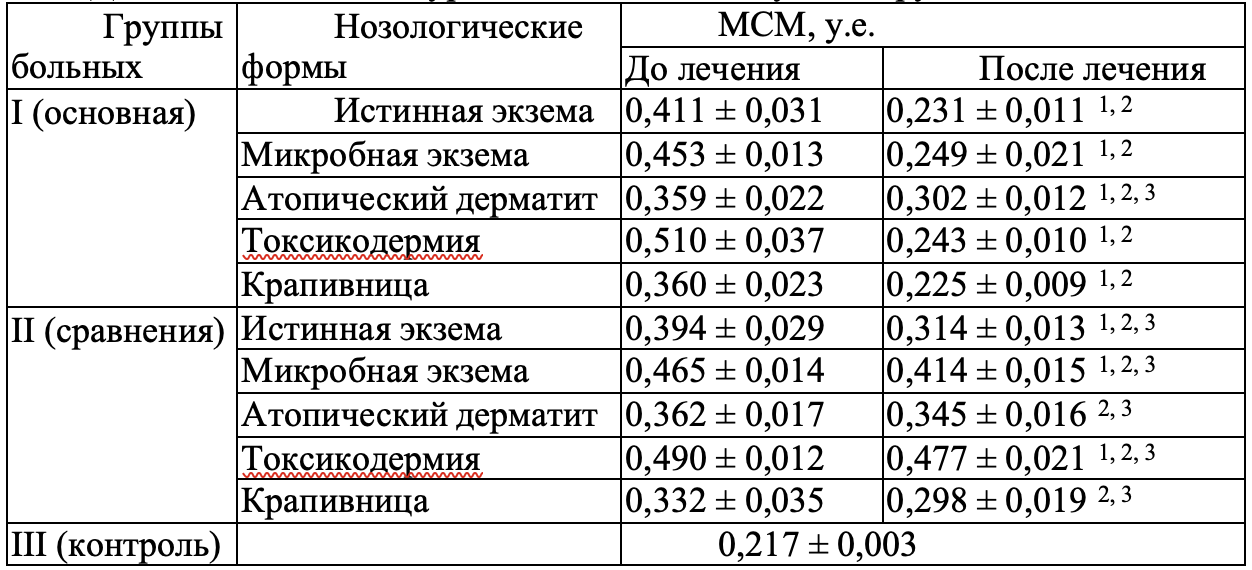
Note: 1 – differences between indicators before and after treatment are significant (p <0.05); 2 – differences between indicators of groups I and II are significant (p < 0.05); 3 - the differences in the indicators of the I and II groups compared to the control are significant (р < 0.05)
During the therapy in the main group of patients, the duration of the general toxic syndrome was significantly shorter by 6.3 ± 1.2 days than in the comparison group.
When evaluating subjective sensations, it was noted that in patients of the I therapeutic group, the intensity of itching decreased by 3.5 ± 1.8 days of therapy, and in patients of the II group - only by 9.2 ± 1.1 days. Acute inflammatory phenomena regressed 6.2 ± 1.1 days earlier in patients receiving complex therapy using Atoxyl. The average duration of clinical manifestations of allergic dermatoses in the main therapeutic group was 1.62 times less than that of patients in the comparison group. After the therapy, the indicators of MSM content in patients with true, microbial eczema, toxicoderma, urticaria and therapeutic group I normalized. In patients with atopic dermatitis, a significant decrease in the indicated indicator was observed. In the II therapeutic group, only a significant decrease in the level of MSM was revealed in patients with true eczema, microbial eczema, and toxicoderma, however, only a tendency toward normalization of indicators was observed in patients with atopic dermatitis and urticaria. Attention is drawn to the fact that in patients with atopic dermatitis in the I and II therapeutic groups, the observed indicator did not reach the norm, which is characterized by the peculiarity of this dermatosis. Normalization of MSM was delayed compared to clinical manifestations. In these patients, it is advisable to repeat the course of enterosorption. Clinical and biochemical comparisons revealed significant differences in the compared groups, which confirmed the advantage of the proposed method of therapy using an enterosorbent in comparison with traditional therapy. Complete clinical remission was achieved in 81.6 % patients with allergic dermatoses who received Atoxyl, and only in 65.3 % patients who received traditional therapy.
Eczema patients of the 1st group with acute clinical manifestations (15 people) noted a significant decrease in itching and soreness in the foci 1.9 ± 0.5 days after external use of Atoxyl. During the examination in the specified time, wetting, purulent discharge were absent, hyperemia, infiltration decreased. In the patients of the comparison group, the indicated changes were observed only after 3.8 ± 0.3 days. In the future, the patients received traditional external therapy. These facts characterize the drug Atoxyl as a highly effective drug for application sorption in patients with eczema in the acute stage of the process.
In patients with atopic dermatitis, we carried out prophylactic treatment with Atoxyl 2 tablespoons 2 times a day (7–10 days) 2 times an hour. Allergodermatosis patients, working with professional eco-pathogens, patients living in ecologically unfavorable regions, as well as in cases of close contact of the patient with a large dose of exoallergens, were prescribed anti-relapse treatment according to the above scheme. The appointment of Atoxyl in such cases made it possible to avoid relapse of the disease or to reduce the severity of the pathological process, to reduce the medication load.
CONCLUSIONS
- 88.8 % patients with allergodermatoses, residents of a large-scale industrial region, present complaints inherent in the general toxic syndrome, 90.8 % patients have gastrointestinal tract diseases, and 73.5 % patients have liver and biliary tract diseases, which must be taken into account in the algorithm of examination and treatment of patients.
- SEI was detected in patients with allergic skin diseases, the severity of which correlates with the severity of the pathological process. The level of dynamics of MSM content has clinical and diagnostic significance for determining the volume of therapeutic measures.
- In the complex therapy of patients with allergic dermatoses, the early use of an enterosorbent is pathogenetically justified, the high therapeutic efficacy of Atoxyl, which allows to eliminate the symptoms of SEI due to the normalization of standard markers of endotoxicosis, is proven. The method of treatment of patients with allergic skin diseases using Atoxyl consists in selecting the drug individually for each patient, taking into account the clinical picture of accompanying pathology and tolerance.
LITERATURE
- Influence of anthropogenic pollutants on the level of incidence of allergic dermatoses in the eastern and western regions of Ukraine / I.I. Mavrov, V.N. Volkoslavskaya, A.L. Gutnev, O.I. Denisenko // Dermatology and venereology. – 2003. – No. 2 (20). – pp. 3–6
- Drannyk G.N. Clinical immunology and allergology: Textbook. allowance – Odessa: AstroPrint, 1999. – 604 p.
- Abramovich L.E. The state of the esophagogastroduodenal and hepatobiliary systems in patients with some types of allergic dermatosis: aspects of etiology, pathogenesis, modern treatment // Practical Medicine. – 2003. – Vol. IX, No. – P. 14–24
- Gromashevskaya L.L. "Medium molecules" as one of the indicators of "metabolic intoxication" in the body // Lab. diagnostics - 1997. - No. - P. 11-16.
- Dorokhin K.M., Spas V.V. Pathophysiological aspects of the syndrome of endogenous intoxication // Anesthesiol. and resuscitation - 1994. - No. 1. - P. 56-60.
- Moroz I.P., Tsyapa N.A. Enterosorption in the complex treatment of children with allergic dermatoses // Pediatrics, obstetrics, gynecology. – 1997. – No. – P. 38– 39.
- Khimkina L.N., Dobrotyna N.A., Kopytova T.V. Significance of endogenous intoxication in chronic dermatoses. Correction methods // Vestn. dermatology and venereology. - 2001. - No. 5. - P. 40-43.
- Medicinal chemistry and clinical application of silicon dioxide / Ed. A.A. Chuyko - K.: Naukova dumka, 2003. - 415 p.
- Alyoshina R.M. Methods of eliminating the syndrome of endogenous intoxication in clinical allergology // Ukrainian Journal of Extreme Medicine named after G.O. Mozhayev. – 2001. – Vol. 2, No. 1. – P. 71–77.
- Lipatova V.I. The experience of using indicators of medium molecules for the diagnosis of nephrological diseases in children // Lab. case – – No. 3. – P. 138–140.
ATOXYL IN COMPLEX THERAPY OF PATIENTS WITH ALLERGODERMATOSIS IN RESIDENTS OF A LARGE INDUSTRIAL CENTER
Savenkova V.V., Yermoshenko O.V.
Resume. The endogenous intoxication syndrome in patients with allergic dermatoses, residents of a large industrial region, is characterized. The etiopathogenetic significance of the use of enterosorbents in complex therapy is substantiated. The therapeutic effectiveness of Atoxyl in the treatment of allergic skin diseases is proven.
Keywords: allergodermatoses, large-scale industrial region, endogenous intoxication syndrome, medium-weight molecules, enterosorption, Atoxyl.
ATHOXYL IN COMPLEX THERAPY OF ALLERGODERMATOSIS PATIENTS LIVING IN BIG INDUSTRIAL CENTRE
Savenkova VV, Ermoshenko OV
Resume. The characteristic of endogenic intoxication syndrome in patients of allergodermatoses who live in a large industrial center has been given. Etiopathogenetic significance of enterosorbents usage in complex therapy has been justified. The therapeutic efficacy of Athoxyl usage in the treatment of allergic skin diseases has been proven.
Key words: allergodermatoses, big industrial center, endogenic intoxication syndrome, average mass molecules, enterosorption, Athoxyl.