
Experience with detoxification therapy for psoriasis in patients of different age groups
Dermatologist 2016 · 07:078–083 UDC 616.517-085.246.9-053.4/.9
O. Protsenko, T. Protsenko, I. Bogatyreva, A. Zablotskaya
Donetsk National Medical University named after M. Gorky
Experience of detoxification therapy of psoriasis in patients of various age groups
The relevance of the problem of psoriasis is connected with the prevalence of dermatosis and the high frequency of its occurrence in different age periods of life, comorbidity with another somatic pathology (metabolic syndrome, cardiovascular diseases, type 2 diabetes), the presence of which aggravates the course of the disease, affects the prognosis and effectiveness of therapy [2, 8]. The presence of a background or previous pathology (angina, streptococcal sensitization, focal infection, parasitic invasion, etc.) and the resulting antibacterial and other medical therapy disrupts the normal microbiocenosis of the intestine and other topographic regions, which collectively affects both the skin condition and the course of dermatoses [3, 4].
It is known that dysbiosis, or intestinal dysbacteriosis, which develops as a result of an infectious pathology or is caused by drugs, affects the immunity as a whole, causes parietal digestion disorders in the intestines, contributes to the development of endogenous intoxication and sensitization [4]. Endogenous intoxication, which develops as a result of background pathology or its treatment, can worsen the course of dermatosis and/or contribute to recurrence [1, 2, 3]. In dermatological practice, "starting" detoxification therapy ("to wipe" the patient) has been used for a long time, which is carried out during the period of examination of the patient before the appointment of basic or disease-modifying therapy [5, 7].
The use of drugs with sorption and prebiotic effects may be an option for such an approach. Eliminal gel is a complex medical preparation containing a highly dispersed silicon sorbent (silicon dioxide) and the prebiotic lactulose, which provides not only a detoxification effect, but also promotes the restoration of intestinal microbiocenosis, thereby providing a mediated anti-inflammatory and immunomodulating effect [4].
Despite the significance of the pathology of the digestive system in the course of chronic dermatoses, so far only single works have been devoted to the assessment of the influence of detoxification therapy on the course of psoriasis.
In connection with this, the goal of our work was to study the clinical and anamnestic features of psoriasis in different age groups and to assess the effectiveness of the detoxification effect using the combined drug Eliminal gel in the complex treatment of patients.
Materials and research methods
60 patients aged from 5 to 46 years with a history of disease from 3 to 18 years, including 32 men and 28 women, were under observation.
All patients underwent a dermatological examination with determination of skin condition, degree of severity of disease symptoms according to the PASI system. A mild course of psoriasis was assessed with a total score of up to 10, a moderate-severe course with a score of 10 to 20, and a severe course with a score of more than 20 [6].
Patients were examined according to generally accepted recommendations with the determination of: comprehensive blood analysis, bilirubin, transaminases, glucose, C-reactive protein, rheumatological tests, creatinine, general urinalysis, as well as ultrasound of the thyroid gland, pelvic organs, and abdominal cavity.
At the first stage of the work, an analysis of the anamnesis, medical documentation and the results of the previous examination was carried out in order to identify persons with background or previous somatic pathology (including intestinal dysbiosis or dysbacteriosis, dyskinesia of the biliary tract, chronic gastritis, pancreatitis, etc.), as well as taking medication (including antibacterial) therapy during the last year. According to the medical documentation, at the time of inclusion in the study, all these diseases were out of exacerbation. An analysis of the frequency of occurrence of these symptoms in comparable age groups of patients with psoriasis was conducted.
At the second stage of work, patients with psoriasis were randomly selected into 2 therapeutic groups: the main group (30 people), whose complex traditional therapy included Eliminal gel, and the comparison group (30 people), who received only traditional therapy. Both groups were representative in terms of the main compared parameters.
Traditional therapy included 311 nm phototherapy, sedatives, vasoactive drugs, hepatoprotectors, external anti-inflammatory and absorbent therapy [1, 5].
The justification for the inclusion in the complex therapy of patients with psoriasis of the combined medical preparation Eliminal gel was the proven detoxification, anti-inflammatory, prebiotic, and immunomodulating effects of its active components [4], as well as permission for use in practice (TUU No. 15.8-37073142-001:2011).
Eliminal gel was prescribed in the following doses: children 5–13 years old — 1 stick pack 2 times a day; 14–18 years old — 1 stick pack 3 times a day; adults over 18 years old — 1 stick package 3 times a day for 10 days, 2–3 such courses with an interval of 1 month [3].
The effectiveness of the proposed method was assessed by analyzing immediate results (dynamics of the PASI index) and remote treatment results (presence and number of relapses during 1 year of observation).
The obtained results were processed by statistical methods using generally accepted programs on a personal computer.
Results and their discussion
Clinical and anamnestic analysis of the characteristics and course of psoriasis in three age groups: children, adolescents, and adults. In our observations, patients with plaque psoriasis prevailed - 45 (75%), including in the age group children - 12 (60%), adolescents - 14 (70%) and adults - 19 (95%).
Rashes in all patients corresponded to the progressive stage of psoriasis, were located in typical places with damage to the extensor surface of the upper and lower limbs, trunk and were represented by bright pink papules and plaques up to 10-15 cm in diameter, dense consistency with varying degrees of peeling in the central part of the foci and an erythematous rim on the periphery of most of the elements.
When analyzing the features of the clinical manifestations of psoriasis in the comparison groups, some differences were revealed (Table 1). Thus, the lesion of the hairy part of the head, which is one of the predictors of the severity of the course of dermatosis, was detected in 12 (60%) patients, including 5 (25%) out of 20 adults with psoriasis, in 6 (30%) out of 20 teenagers with psoriasis, and only in 1 (5%) out of 20 children with psoriasis.
Lesions of large folds, also reflecting the risk of a more severe course of dermatosis, were detected in 19 (31.7%), more often in the group of children with psoriasis - in 9 (45%), somewhat less often in adult patients - in 6 (30%) and in teenagers - in 4 (20%).
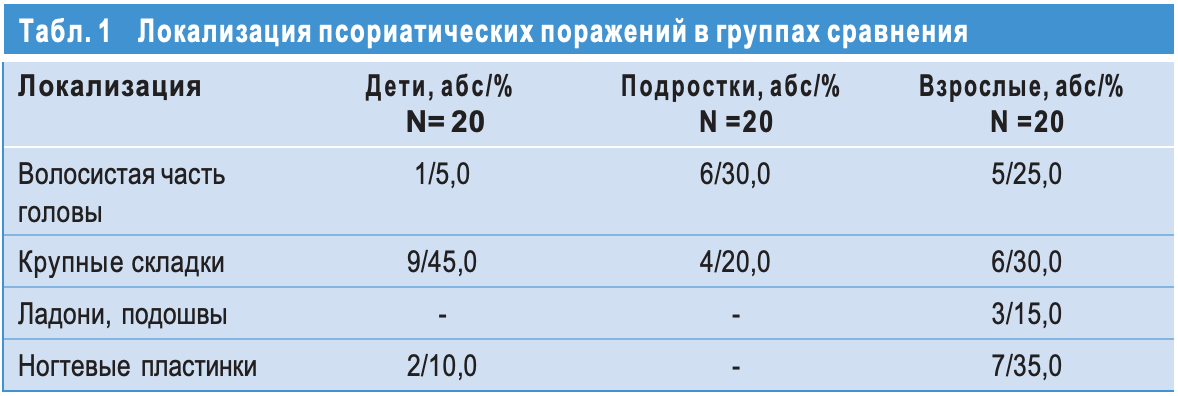
The average PASI index was 13.8±1.23, including 8.6±0.92 in the group of children, 14.2±1.41 in the group of adolescents with psoriasis, and 18.6±1.52 in adults with psoriasis.
Of special interest was the analysis of the anamnesis of patients with psoriasis and its comparison in different age groups from the point of view of the influence on the intestinal microbiocenosis and the possible subsequent course of dermatosis ( Table 2).

In our observations, there was not one of the 60 patients included in the study with an uncomplicated previous history, including in the group of children. It was noteworthy that over the past year, 17 (28.3%) patients took antibiotics for various diseases, while every fifth child and teenager with psoriasis - 4 (20%) patients in these groups and almost every second adult - 9 (45.0%). Chronic viral infection (CVI) was present in 22 (36.7%) patients, more often in children - in 9 (45.0%) and in almost every third adolescent and adult - in 7 (35.0%) and 6 (30.0%) patients, respectively. According to the medical documentation, dysbiosis or dysbacteriosis was previously established in 14 (23.3%) patients, including 8 (40%) children with psoriasis, 4 (20%) adolescents and 2 (10%) adults.
In connection with the above, it is not surprising that every third patient had a history of chronic gastritis, pancreatitis, etc. - 26 (43.3%) patients, with an increasing frequency of occurrence from children - 6 (30.0%) patients, to adolescents - 8 (40.0%) and adults - 12 (60%) patients.
Clinical and anamnestic comparisons in 22 (36.7%) patients revealed an exacerbation or worsening of the course of dermatosis on the background or after disturbances in the digestive system, including 11 (55%) children, 5 (25%) adolescents and 6 (30%) adults with psoriasis.
An analysis of immediate and distant results of treatment of psoriasis patients in two comparison groups was carried out.
Tolerability of treatment in all patients was satisfactory. Eliminal gel was well tolerated by all patients. Monitoring of general clinical analyzes did not reveal any changes in observed patients during treatment.
Regression of clinical symptoms of psoriasis (PASI 50% – 75%) was observed in all patients in the comparison groups, however, it was more pronounced in patients of the main group, whose complex therapy included taking Eliminal gel (Table 3). The PASI index decreased in all age groups, but it was especially pronounced in children with psoriasis whose complex therapy included Eliminal gel.
Complete remission at the end of the treatment course was achieved in 36 (60.0%) patients with psoriasis, including in 21 (70.0%) patients of the main group and in 15 (50.0%) in the comparison group (Table 4). When comparing the age groups, it was noted that 8 out of 10 children with psoriasis in the main group had complete clinical remission after treatment and only 6 out of 10 in the comparison group; in 7 out of 10 teenagers with psoriasis in the main group and only in 5 out of 10 in the comparison group; in 6 out of 10 adults with psoriasis in the main group and in 4 in the comparison group.
However, the most significant differences are noted in the analysis of long-term treatment results (Table 5). Yes, remission was less than 1 year in 6 (10.0%) patients, including in every fifth patient with psoriasis in the comparison group - in 6 (20.0%) patients and in none of the 30 patients with psoriasis in the main group treated with Eliminal gel. Remission for more than 2 years was established in 26 (43.3%) patients, including in 18 (60.0%) patients of the main group and only in 8 (26.7%) in the comparison group.
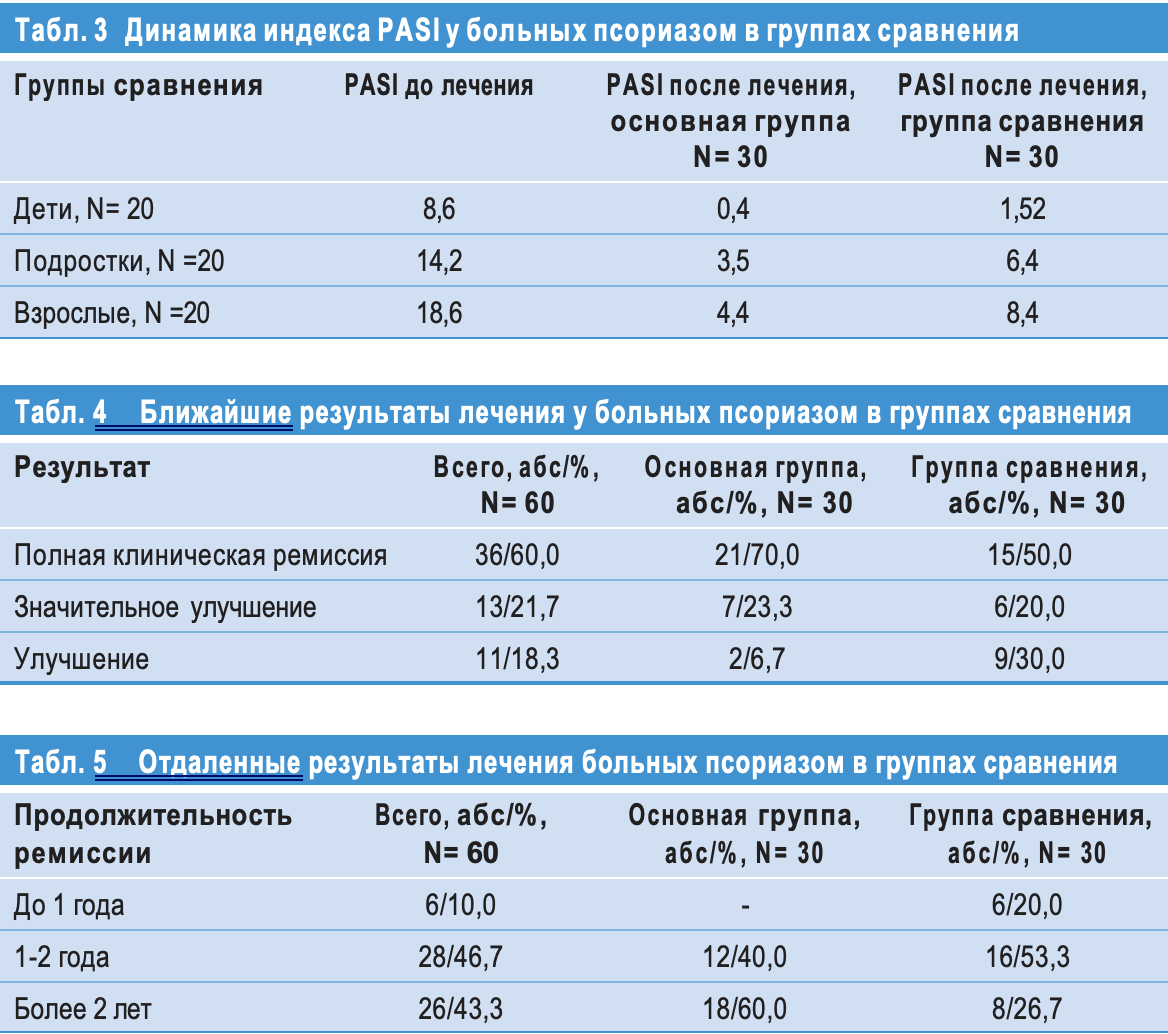
When analyzing the long-term results of treatment, it was noted that there were annual relapses in 25 (41.7%) patients, including in 19 (63.3%) patients with psoriasis in the comparison group and only in 6 (20.0%) patients in the main group. Recurrences during 2 years of observation were in 31 (51.7%) patients, including in 9 (30.0%) patients of the main group and in 22 (73.3%) patients of the comparison group.
Special attention was paid to the analysis of treatment results in age groups. Thus, annual exacerbations of psoriasis in children were observed in 4 (20.0%) patients with psoriasis, including in 4 out of 10 patients of the comparison group and in none of 10 children with psoriasis of the main group, whose complex therapy included the use of Eliminal gel. Relapses occurred during the 2 years of observation in 9 (45%) children with psoriasis, including in 8 out of 10 patients in the comparison group and only in 1 out of 10 children with psoriasis in the main group.
The obtained data once again confirm the thesis about the role of intestinal microbiocenosis in the development and course of dermatological pathology and the importance of detoxification therapy in the staged management of patients. The combination of silicon dioxide sorbent with lactulose, which promotes faster intestinal colonization by bifidobacteria and lactobacilli, restores intestinal microbiocenosis, thus providing and enhancing a wide range of therapeutic effects (detoxification, immunomodulating, anti-inflammatory, antiallergic, etc.), explains the expediency of using Eliminal gel in dermatological practice.
If silicon dioxide is allowed for use from 1 year of age, then the second active component of Eliminal gel - lactulose, is used in children older than 6 weeks, as well as in pregnant and lactating women, the elderly and even in people who have undergone resection of hemorrhoidal nodes, after which it is very difficult to ensure the selection of adequate drugs with similar effects. The combination of lactulose with a silicon sorbent allows you to level the negative effect of the latter on intestinal peristalsis and reduce the risk of constipation, which is quite important in the treatment of patients with dermatoses.
Probably, it is these features of the therapeutic action and a wide range of therapeutic effects of Eliminal gel that ensure the high effectiveness of the treatment of psoriasis in people of various age groups.
Resume
Dermatologist 2016 · 07:078–083
O. Protsenko, T. Protsenko, I. Bogatyreva, A. Zablotskaya
Experience of detoxification therapy of psoriasis in patients various age-related group
Purpose of work - to study the effectiveness of detoxification in the complex treatment of children, adolescents, and adults with psoriasis.
Material and methods: clinical features and treatment were studied in 60 psoriasis patients of three age groups: 20 children aged 5 to 12 years, 20 adolescents aged 13 to 18 years and 20 adult patients aged 19 to 46 years. The detoxification effect was carried out with the help of the combined drug Eliminal gel. The effectiveness of the therapy was assessed by the immediate and distant results of the treatment of patients in two comparison groups: the main group (30 patients), whose complex therapy included Eliminal gel, and the comparison group (30 patients), treated traditionally.
Results and discussion. Clinical and anamnestic analysis revealed that 28.3% patients with psoriasis received one or another drug therapy during the last year due to somatic pathology that could have a detrimental effect on intestinal microbiocenosis, 23.3% patients previously had dysbacteriosis or intestinal dysbiosis, 36.7% patients with psoriasis noted a connection between exacerbation of psoriasis and gastrointestinal dysfunction Complex therapy of patients with psoriasis with the use of Eliminal gel was well tolerated by patients of all age groups, and achieved sustained remission for more than 2 years in 60% patients of the main group, compared to 26.7% patients treated traditionally.
Conclusions. The inclusion of Eliminal in the complex therapy of psoriasis in patients of various age groups significantly increases its effectiveness, increases the duration of remission and reduces the number of relapses by 1.5-2 times.
Key words
psoriasis · children · teenagers · adults · treatment · Eliminal
O.A. Protsenko, T.V. Protsenko, I.N. Bondarenko, A.G. Zablotska
Detoxification therapy experience psoriasis in patients of different age groups.
Purpose of work – to study efficiency designToxicological intervention in the complex treatment of psoriasis patients in children, adolescents and adults.
Material and methods: The clinical features and course of psoriasis were studied in 60 patients of three age groups: 20 children aged 5 to 12 years, 20 adolescents aged 13 to 18 years and 20 adults aged 19 to 46 years. Detoxification intervention was performed using Eliminal gel. The effectiveness of therapy was assessed based on the results of treatment of patients with psoriasis in 2 comparison groups: the main group (30 patients), whose complex therapy included Eliminal gel, and the comparison group (30 patients) receiving traditional therapy.
Results and their discussion. Clinical historyIt was found that 28.31% of psoriasis patients had taken one or another therapy that suppressed the intestinal microbiocenosis during the last year, 23.31% of patients had previously had intestinal dysbiosis or dysbacteriosis; 36.71% of patients noted a connection between exacerbations of psoriasis and digestive system disorders. Complex therapy of psoriasis patients with the use of Eliminal gel contributed to achieving remission for more than 2 years in 60.01% of patients in the main group and only in 26.71% of patients in the comparison group.
Conclusions. The use of Eliminal in the complex therapy of patients with psoriasis significantly increases the effectiveness of therapy, prolongs the duration of remission, and reduces the number of relapses by 1.5-2 times.
Key words
psoriasis · children · teenagers · adults · clinic · treatment · Elimenal
O.A.Protsenko, TV Protsenko, I.N. Bondarenko, A.G. Zablotska
Detoxification experience treatment of psoriasis in patients with different ages
The purpose of the research was this study the influence of detoxification therapy of the treatment patients with psoriasis of the different age group.
Mamaterials and metods: 60 patients with psoriasis in the different age groups are studied. Patients were divided into 2 therapeutic groups. The comparison group consisted of 30 patients, treated traditionally and the main group – 30 patients, treated with Eliminal gel.
Rthere areresults and discussions. Clinical analysis showed the higher results in patients treated with the use of Eliminal gel. Recurrence of psoriasis until 1 year was 63.3% patients while only 20% patients treated with Eliminal gel.
Conclusions. Combined treatment psoriasis in patients with the use of Eliminal gel are more effective compared to traditional therapy.
Keywords
Conclusions
- Clinical and anamnestic analysis showed that all 60 are included was in the study of patients aggravated history, incl. 28,3% patients with psoriasis duringlast year they received that or other medicinal therapy in due to somatic pathology, which could cause harmnoe influence on microbiocenosis intestines; 23.3% patients previously had dysbacteriosis or dysbiosis intestines; 36.7% patients with psoriasis have an acute relationshipny dermatosis or its deterioration currents with violations systems digestion.
- Including Eliminal gel in complex therapy of psoriasis significantly increases its effecttiveness, increases lengththe duration of remission and decreases the number of relapses is 1.5-2 times.
- Eli's combined drugpast gel maybe to apply in children and adults, it is different good tolerance and othersby invasive way of introduction.
Address for correspondence
T.V. Protsenko Doctor of medicine, professor, head of the department dermatovenerology and cosmetology of the DNMU named after M. Gorky
O.A. Protsenko
Doctor of Medicine, professor of the department of dermatovenerology and cosmetology of the DNMU named after M. Gorky
Conflict interests: The authors declare that there is no conflict of interest.
Literature
- Clinical recommendations. Dermatovenerology / Ed. A.A. Kubanova. - M.: DEKS-Press, 2007. - P. 143-153.
- Kochergin N., Smirnova L., Potekaev N. Psoriasis: comorbidity and comedicity //Vrach. – 2009. – No. 5. – P. 15 – 20.
- Microecology of the vagina. Correction of microflora in vaginal dysbacteriosis/ Study guide. Ed. V.M. Korshunova et al. M.: VUNMC of the Ministry of Health of the Russian Federation, 1999. – 80 p.
- Pinegin B.V., Korshunov V.M., Shkarupeta M.M., Maltseva N.N. Indigenous microorganisms as immunomodulators/Collection of works "Immunomodulators". - M., 1987. - P. 149-156.
- Rational diagnostics and treatment in dermatology and venereology/Edited by I.I.Mavrova. – Kyiv: Health of Ukraine, 2007. – 344 p.
- Fouere S., Adjadj L., Pawin H. How patients experience psoriasis: results from a European survey// – 2005. – Vol. 19, N 3. - P. 2-6.
- D., LottiT.M. European Handbook of Dermatological Treatments. - Springer-Verlag Berlin Heidelberg, 1999. - 384
- Psoriasis /Ed by H. Roenigk, J. Maibach. - Marcel Dekker: New York, 1991. - 204