
Stepped enterosorption as an optimal method for correcting intestinal microbiocenosis in patients with allergic dermatoses.
UDC 616.521-053.2.085+615.454.1
STEPPED ENTEROSORPTION AS AN OPTIMAL METHOD OF CORRECTION OF INTESTINAL MICROBIOCENOSE IN PATIENTS WITH ALLERGODERMATOSES
Y.F. Kutasevich, I.A. Oleynyk, S.K. Joraeva, V.Yu. Mangusheva
State University "Institute of Dermatology and Venereology of the National Academy of Medical Sciences of Ukraine"
Resume. IN article are given data at therapeutic efficiency stepwisethat of enterosorption with the use of atoxyl and eliminal gel in patients with allergic dermatoses, taking into account the study of the general condition, subjective and objective complaints, and intestinal microbiocenosis before and after the therapy.
Keywords: Allergodermatosis, intestinal microflora, dysbacteriosis, graded enterosorption.
INTRODUCTION
According to WHO data, allergic diseases (AD) take third place in the world after cardiovascular and oncological pathologies. In Ukraine, the prevalence of AZ also continues to increase, especially among the population of industrially developed regions. [1].
One of the causes of AZ is considered to be a greater antigenic load on the body due to the combined effect of natural and anthropogenic factors, in particular man-made pollutants.
In addition to exogenous factors, researchers also identify endogenous risk factors for the development of hypersensitivity of the body, primarily burdened heredity. It is known that 40 % people have a hereditary tendency to atopy, and this contingent of the population is particularly sensitive to adverse environmental conditions. Over time, these individuals develop AZ with an elevated level of IgE, i.e. atopic AZ. Often there is a combined effect of several factors on the body: an unfavorable environmental situation, professional values, social conditions, etc., which primarily affects patients with a hereditary predisposition. [12].
A significant role in the formation of allergies is played by accompanying diseases of the liver, kidneys, digestive tract, respiratory system, skin, etc. The analysis of the physical status of allergic patients showed a high percentage (67.5 %) of accompanying pathologies, especially pathologies of the liver (chronic hepatocholecystitis, gallstone disease, dyskinesia of the biliary tract), kidneys. These diseases play an important role in the pathogenesis of relapses of AZ both with and without an immunological mechanism of development. [3].
Particular attention should be paid to the gastrointestinal tract in patients with allergic dermatoses. In almost 100 % patients, various disorders of the gastrointestinal tract are observed. Dyskinesia of the biliary tract is found in more than half of the examined patients, gastroduodenitis and pancreatitis in a third, changes from intestinal microbiocenosis are detected in almost all patients with AZ during examination. [9].
In addition to disturbed intestinal microflora, the composition of the skin microflora changes in patients with allergic diseases, which leads to the deterioration of each process, the addition of bacterial and mycological infections [2].
There are two types of disturbed intestinal microbiocenosis: the first type is characterized by a decrease in the amount of normal intestinal microflora. The barrier function of the gastrointestinal tract is disturbed due to the thinning of the biofilm on 95% consisting of bifidobacteria. A decrease in the number of bifidobacteria leads to the development of the third degree of severity of dysbiosis, regardless of the number of other representatives of the normal flora. Food sensitization occurs. With the second type of dysbiosis, a large amount of infectious antigens enters the mucous membrane, and then the systemic bloodstream. As a result, the amount of conditionally pathogenic flora increases, which contributes to sensitization and deterioration of the course of each process. [4,5].
Enterosorption is one of the optimal, simple and physiological methods of stopping toxicosis, binding and elimination. This method of efferent therapy is aimed at the treatment of intoxication syndrome in various diseases, based on the ability of enterosorbents to bind and remove from the body various exogenous substances, microorganisms and their toxins, endogenous intermediate and end products of metabolism that can accumulate or penetrate into the cavity of the gastrointestinal tract during the course of the pathological process. [11]
The method of sorption detoxification of the body is based on four scientifically proven mechanisms for reducing the systemic concentration of toxic substances and metabolites. The first one assumes the possibility of the reverse passage of toxic substances from the blood into the intestines with their further binding on sorbents (similar to the mechanism of intestinal dialysis). The second is reduced to cleaning the digestive juices of the gastrointestinal tract, which contain a significant amount of toxic substances. The third one consists in the modification of the lipid and amino acid spectra of the intestinal contents (due to the selective absorption of free fatty acids by the sorbent). The fourth is to remove toxic substances formed in the intestine itself, restore the integrity and permeability of mucous membranes and reduce the functional load on the liver, which allows to more fully use its detoxification potential to mitigate the manifestations of systemic toxicosis and improve the functional state of the gastrointestinal tract as a whole. When using enterosorbents (ES) for this pathology, the removal of allergens, allergy mediators and a wide range of substances involved in immune reactions is achieved. [6,7-13].
Purpose The research was a study of the therapeutic effectiveness of stepwise enterosorption using atoxyl and eliminal gel.
MATERIALS AND METHODS
The study included 30 patients with allergic dermatoses aged 17 to 67 years (17 men and 13 women – 56.7 % and 43.3 %, respectively). According to clinical and anamnestic data, chronic eczema was detected in 7 (23 %) patients, allergic dermatitis in 6 (20%) patients, microbial eczema in 6 (20 %), atopic dermatitis in 5 (17 %), toxicoderma in 4 (13%), urticaria in 2 (7 %) examined (Fig. 1).
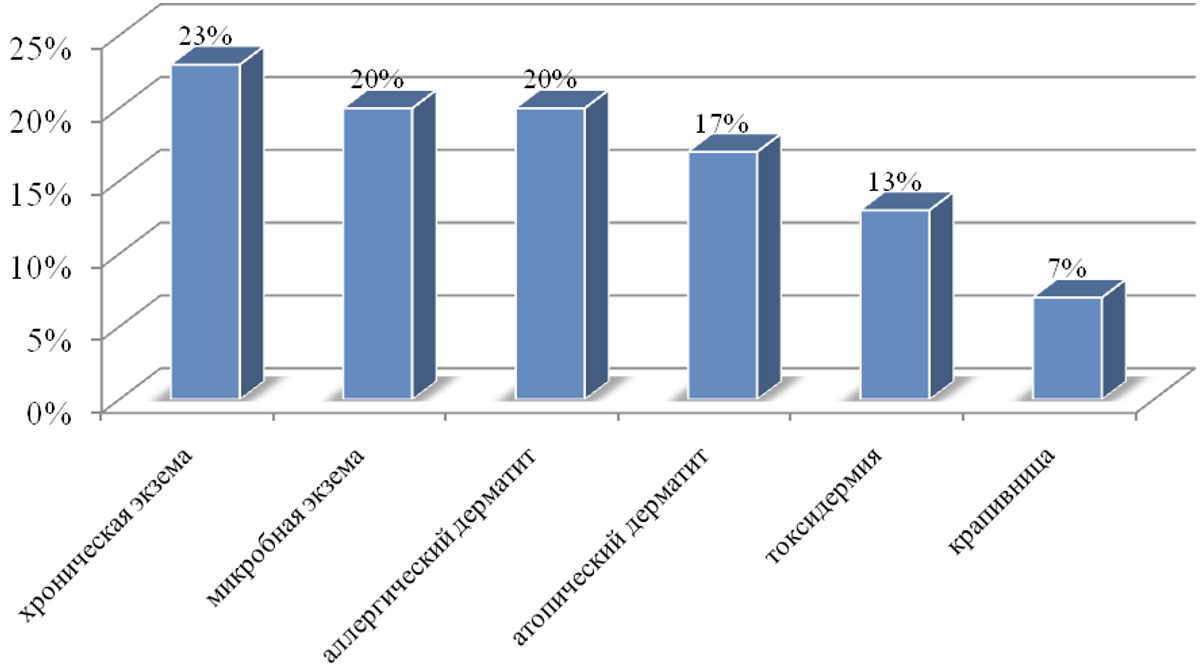
Rice. 1. Classification of patients according to nosological forms
The diagnosis was established on the basis of complaints, anamnestic data, clinical picture, and the results of an objective examination. All patients underwent laboratory tests at the beginning and end of treatment (general analysis of blood, urine, biochemical analysis of blood with determination of glucose, total protein, total bilirubin and its fractions, ALT, AST, microbiological analysis of feces).
Microbiological examination of feces was carried out on the basis of the bacteriological laboratory of the regional SES of Kharkov, the laboratory is certified for conducting these studies (attestation certificate No. 100-163/2013 dated 06.06.2013, valid until 06.05.2016) and has a permit to work with pathogens of the III-IV groups of pathogens (No. 130/28-12 dated 12/21/2012, valid until 12/21/2017).
Bacteriological examination of feces and the degree of dysbiotic disturbances were evaluated according to the unified working classification of Kuvaeva-Ladodo. [13]. The severity of intestinal dysbacteriosis was assessed by sowing serial diluted feces [14], using dense and liquid nutrient media: Endo, Ploskyrev, Saburo, Simmons, Olkenytskyi, Wilson-Blair, Blaurokk, and others.
Atoxyl is a highly active silicon sorbent of the IV generation with an active absorption surface area of more than 400 m²/g, enhances the transport of food and bacterial allergens, a variety of toxic products, including medium molecules, oligopeptides, amines and other substances formed in the process of protein decay in the intestine, from the internal environment of the body (blood, lymph, interstitium), into the digestive tract due to concentration and osmotic gradients with their subsequent removal from the body. In the 90s of the last century, the unique properties of Atoxyl were discovered. Atoxyl has an electrostatic ability of sorption, due to which the drug, dissolving in water, acquires a negative charge and, accordingly, attracts everything that is positively charged. However, useful microflora, vitamins and microelements that have a neutral charge are not absorbed by them. In addition, this drug inactivates a large protein molecule in comparison with other enterosorbents.
Eliminal gel is a combined preparation that contains a highly active silicon sorbent and synthetic disaccharide lactulose. The drug has an antimicrobial effect, has a mediated detoxification, bactericidal and bacteriostatic effect against pathogenic and conditionally pathogenic bacteria and fungi. It has a targeted effect on the elimination of pathogenic bacteria and enterotoxins, allows to restore intestinal microbiocenosis and stimulate the growth and development of normal flora - bifidobacteria and lactobacilli. The components of the drug have a complementary and reinforcing effect in the correction of conditions associated with disorders of the gastrointestinal tract.
To assess the therapeutic effectiveness of stepwise absorption, all examined patients were divided into two groups. Group I patients received traditional treatment and step-by-step therapy: Atoxyl 1 bottle per day for 3 days followed by eliminal gel 1 stick package 3 times a day for 14 days; Group II patients – traditional treatment without the use of enterosorption.
Evaluation of the therapeutic effectiveness of the proposed stepwise scheme of enterosorption included the dynamics of subjective data (complaints about itching, burning, dryness) and objective data examined (skin process, as well as the state of intestinal microflora was studied dynamically).
RESULTS OF RESEARCH
In the main group, on the background of the application of the step-by-step scheme of the use of Atoxyl and Eliminal-gel, the improvement of the general condition in the control group was noted for 2–4 days, on the background of only basic therapy in the comparison group - for 7 days. Complete regression of each process in the main group was noted on days 9–11, in the comparison group – on days 14–17.
After the therapy, itching was reduced 3–4 days earlier in the patients of the main group than in the comparison group.
The most pronounced therapeutic effect was observed in patients with toxidermia. This group consisted of patients suffering from alimentary, less often drug-induced toxidermia of mild and moderate severity. Regression of the rash was noted on the 2nd–3rd day, which was two days earlier than in the patients of the comparison group.
In patients with eczema (microbial and true), there was a regression of acute inflammatory rashes, a decrease in the area of lesions 2–3 days earlier than in the comparison group.
As a result of the studies conducted before the treatment, a violation of the microbiocenosis of the large intestine was revealed in all 30 people (100.0 %). Thus, grade I dysbacteriosis was detected in 3 (10.0 %), grade II – in 16 (53.3 %), grade III – in 11 (36.7 %) examined persons.
Dysbiotic disorders were characterized by a decrease in the quantitative content of indigenous microflora - representatives of both aerobic and anaerobic bacteria. Most often, a decrease in the number of bifidobacteria was noted in patients - in 9 (30 %) people. In addition, a decrease in lactobacillus seeding rates was noted in 4 (13.3 %) patients and normal Escherichia coli in 3 (10 %) patients. These indicators deserve attention, since these microorganisms, on the one hand, provide colonization resistance of the intestinal biotope, preventing the penetration and fixation of pathogenic agents on the mucous membrane; and on the other hand, they are natural biosorbents that prevent the absorption of allergens in the intestines and stimulate the synthesis of Ig A - the main antibodies against food allergens.
An increase in the number of conditionally pathogenic microorganisms (H. alvei, K. pneumoniae, Proteus spp., E. aerogenes) was revealed in 25 (83.3 %) patients. Against the background of a qualitative imbalance of the microflora, changes in the quantitative composition were also revealed: E. coli with hemolytic properties was detected in 9 (30.0 %) patients, lactose-negative E. coli in 6 (20.0 %) and E. coli with reduced enzymatic activity in 2 (6.7 %) patients. The frequency of detection of Candida and S. aureus fungi attracts attention - in 22 (73.3 %) and 4 (13.3 %) examined, respectively. Thus, the revealed violations of the colonization resistance of the intestinal biotope, associated with a change in the composition of the permanent microflora, contribute to its colonization by pathogenic and conditionally pathogenic microorganisms, which leads to the formation of dysbiosis and, as a consequence, to the strengthening of food sensitization.
During the microbiological examination of the feces of the main group (15 people) after the treatment, a persistent trend in the normalization of the main indicators of the intestinal biota was noted. Thus, grade I dysbacteriosis was detected in 2 (13.3 %), grade II – in 6 (40.0 %), grade III – in 2 (13.3 %) examined (before treatment 10.0 %, 53.3 % and 36.7 %, respectively); in 5 people (33.3 %) against the background of the therapy, a complete normalization of all indicators was noted. Also, in the patients of this group, the normalization of the content of lactobacilli and bifidobacteria was noted - 14 people (93.3 %), in all 15 patients, the total number of typical Escherichia coli was restored with a complete absence of hemolytic cocci and opportunistic forms of enterobacteria. Also, after the complex therapy, there was a decrease in the indicators of insemination by fungi of the genus Candida from 73.7 % to 26.7 %.
During bacteriological examination of feces in patients of the comparison group (15 people), positive changes in the intestinal biota were significantly less pronounced. Dysbacteriosis of the I degree was revealed in 4 (26.6 %), II degree – in 10 (66.7 %) patients, III degree – in 1 (6.7 %) of the examined. Basically, there was a decrease in the content of bifidobacteria (in 33.3 % examined), lactobacilli (13.3 % patients), typical Escherichia coli (6.7 % patients) and an increase in the content of Escherichia coli with hemolytic activity (40.0 %), lactose-negative forms (13.3 %) against the background of the detection of Escherichia coli with reduced enzymatic activity (6.7 %), as well as conditionally pathogenic microorganisms (53.3 %), coccal forms of bacteria (S. aureus - 6.7 %) and the presence of Candida fungi (53.3 %). Thus, the need for additional correction of the biotope clinically remained.
The following diagrams show the dynamics of the main indicators characterizing the state of intestinal cenosis before and after the therapy (Figs. 2, 3).
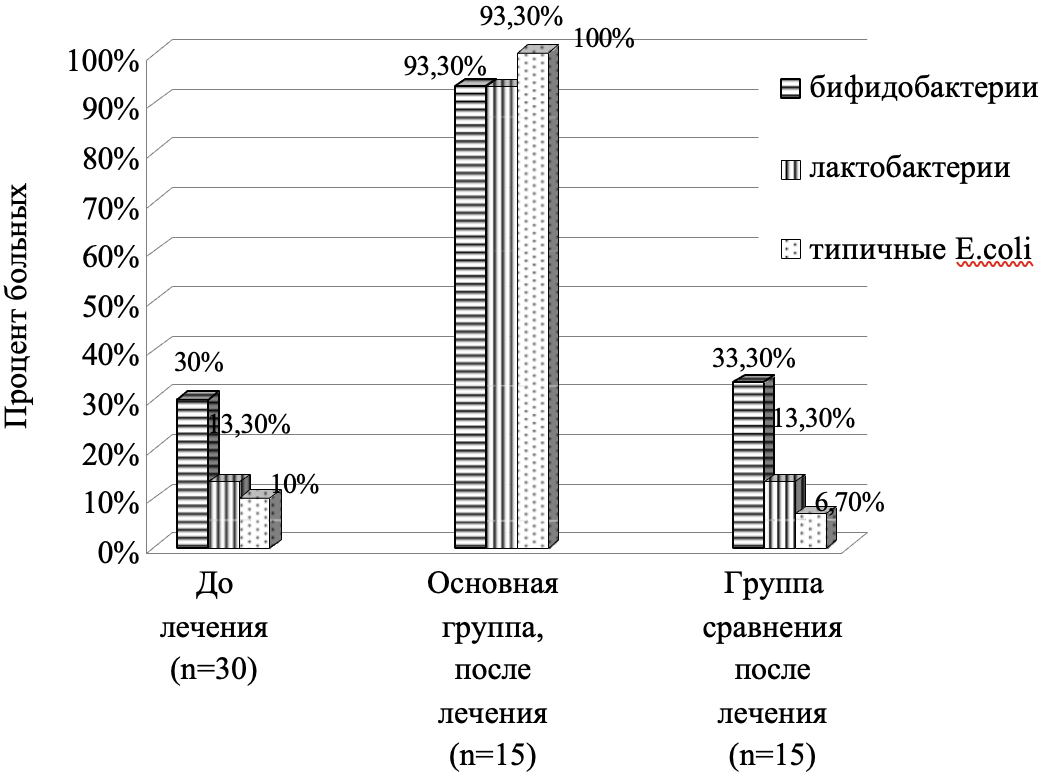
Rice. 2. Dynamics of the main indicators of intestinal biota
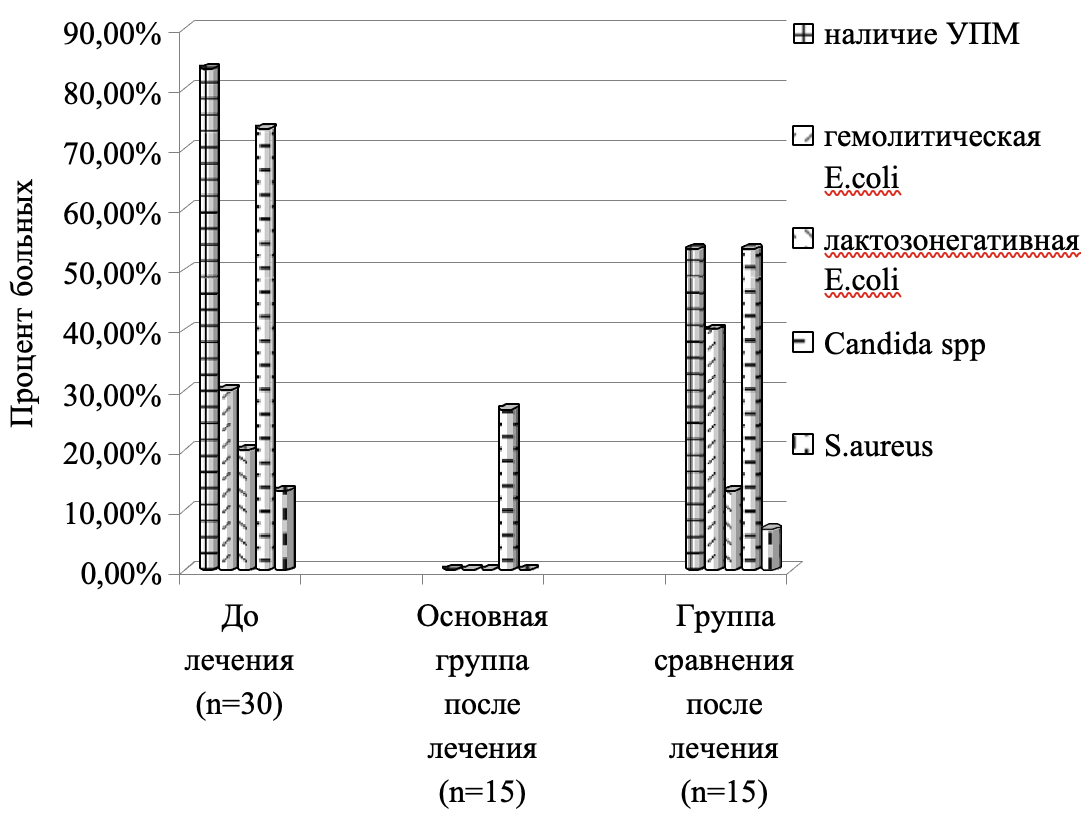
Rice. 3. Dynamics of clinically significant microorganisms in intestinal cenosis
A microbiological evaluation of the effectiveness of the method of treatment of allergic dermatoses using graded enterosorption was carried out. The microbiological effectiveness of the therapy consisted in the normalization of the number of bifidobacteria and lactobacilli, the absence of opportunistic enterobacteria, and a 2.7-fold decrease in the number of fungi of the genus Candida, improvement of the qualitative composition of intestinal biota with disappearance S. aureus, lactose-negative and hemolytic E. coli.
CONCLUSIONS
Based on the above, efferent therapy of people with allergic diseases is pathogenetically justified and occupies a worthy place in the arsenal of modern means of rehabilitation of such patients. The developed method of treating allergic dermatoses with the use of graded enterosorption therapy has high therapeutic efficacy, is well tolerated by patients, and is practically harmless, allowing even without the additional appointment of lactobacilli and bifidobacteria to normalize intestinal biocenosis: reduce the content of pathogenic microflora and increase the content of beneficial ones.
LITERATURE
- Berzhets V.M. Potentiated form of allergen for specific allergy vaccination of patients with atopic diseases / A.I. Berzhets, I.A. Koreneva, M.N. Melnikova // Bulletin of new medical technologies. -2005. – No. 3/4 – P.67-69
- Bondarenko V. M. Intestinal dysbacteriosis in adults / V. M. Bondarenko, N.M. Gracheva, T.V. Matsulevych. - M.: KMK. - 2003. - 224 p.
- A.S. Botkina Dermatological manifestations of diseases of the gastrointestinal tract / A.S. Botkina, S.V. Belmer // Materials of the XIV Congress of Children's Gastroenterologists of Russia. - M.,
- Butorova L. I. Possibilities of correction of intestinal microbiocenosis disorders with lactulose / L. I. Butorova, A. V. Kalinin // Russian. journal gastroenterol., hepatol., coloproctol. - 2008. - No. 1. - P. 79-83
- Veselova L.V. Composition of microbiocenoses in patients with allergic dermatosis / L.V. Veselova, I.V. Hamaganova, M.I. Savina // IV scientific and practical conference "Socially significant diseases in dermatovenerology. Diagnostics, therapy, prevention" - 2006. - P.36-37.
- Hrynevych V.B. Principles of intestinal dysbiosis correction / V.B. Hrynevych, S.M. Zakharenko, G.A. Osipov // Treating doctor. – 2008. – No. 6. - P.6-9.
- Kopanev Yu.A. Intestinal dysbiosis: microbiological, immunological, clinical, micrological aspects. / Yu.A. Kopanev, A.L. Sokolov // M., 2002. – 147p.
- Kuvaeva I.B. Microecological and immune disorders in children / I.B. Kuvaeva, K.S. Ladodo. - M.: Medicine, 1991.
- Litynska T.O. The role and place of pancreatic enzymes in the treatment of patients with acute and chronic skin diseases / T.O. Litynska // Ukr. Journal of Dermatology, Venereology, and Cosmetology – 2009. – 4(35).
- Nikolaev, V.G. Nikolaev // Bulletin of the problems of biology and medicine. - 2007. - No. 4. - P.7-17.
- Novokshonov A. A. Clinical effectiveness of a new enterosorbent in complex therapy of acute intestinal infections of viral etiology in children / A. A. Novokshonov, N.V. Sokolova, T.V. Berezhkova, A.A. Sakharova // Treating Physician. – 2009. – No. 7– C.78-80.
- Pukhlyk B.M. The state of immunity of the population of Ukraine and ways of its correction / B.M. Pukhlyk // Medicines of Ukraine.– – No. 9. – P.32- 33.
- Uchaikin V.F. Enterosorption - the role of enterosorbents in complex therapy of acute and chronic gastroenterological pathology. / V.F. Uchaikin, A.A. Novokshonov, N.V. Sokolova, T.V. Berezhkova // Handbook for doctors. - M., 2008.-24 p.
- Methodical guidelines for bacteriological diagnosis of intestinal dysbacteriosis (for employees of the bak.laboratories of the SES of the Dnieper railway). - Dnipropetrovsk, 2001. - 7 p.
REFERENCES
- Berzhets VM, Koreneva, IA, Melnikova MN Potentsirovannaya forma allergena dlya spetsificheskoy allergovaktsinatsii bolnyih s atopicheskimi zabolevaniyami // Vestnik novyih meditsinskih tehnologiy.− 2005. − N 3/4. - S.67-69. (Russian)
- Bondarenko VM, Gracheva NM, Matsulevich TV Disbakteriozyi kishechnika u vzroslyih, – : KMK, 2003. - 224 s. (Russian)
- Botkina AS, Belmer SV Dermatologicheskie proyavleniya zabolevaniy ZhKT // Materialyi XIV Kongressa detskih gastroenterolov Rossii. - M., 2007. (Russian)
- Butorova I., Kalinin AV Vozmozhnosti korrektsii narusheniya kishechnogo microbiotsenoza lactulozoy // Ros. zhurn. gastroenterol., hepatol., coloproktol. - 2008. - No. 1. - S. 79-83. (Russian)
- Veselova V., Hamaganova V., Savina MI Sostav microbiotsenozov u bolnyih allergodermatozami // IV nauchno-prakticheskaya konferentsiya "Sotsialno znachimyie zabolevaniya v dermatovenerologii. Diagnostika, terapia, profilaktika".− 2006.− S.36-37.(Russian)
- Grinevich B., Zaharenko SM, Osipov GA Printsipyi korrektsii disbiozov kishechnika // Lechaschiy vrach. – 2008. – N 6. – S.6-9. (Russian)
- Kopanev A., Sokolov AL Disbakterioz kishechnika: microbiological, immunological, clinical, micrological aspects. - M., 2002. - 147s. (Russian)
- Kuvaeva B., Ladodo KS Mikroekologicheskie i immunnyie narusheniya u detey. – M.: Meditsina, 1991. (Russian)
- Litinska O. The role and role of enzymes of the pidshlunkovoyi zalozi in the treatment of acute and chronic skin diseases // Ukr. zhurn. dermatol., venerol., kosmetol. – 2009. – 4(35).(Ukrainian)
- Nikolaev VG Enterosorbtsiya: sostoyanie voprosa i perspektivyi na buduschee // Vestnik problem biologii -2007. -N 4.- S.7-17. (Russian)
- Novokshonov AA, Sokolova NV, Berezhkova V., Saharova AA Klinicheskaya effektivnost novogo enterosorbenta v kompleksnoy terapii stryih kishechnyih infektsiy virusnoy etiologii u detey // Lechaschiy Vrach. − 2009.−N 7.– C.78-80. (Russian)
- Puhlik BM State of immunity of the population of Ukraine and ways of its correction // Liki Ukrayini. − 2010. − N9. − P.32-33.
- Uchaykin VF, Novokshonov AA, Sokolova NV, Berezhkova TV Enterosorption – the role of enterosorbents in complex acute and chronic gastroenterological pathology // Posobie dlya −M., 2008.–24s. (Russian)
- Methodological instructions for the diagnosis of dysbacteriosis of the intestine (dlya rabotnikov bak.laboratoriy SES Pridneprovskoy zheleznoy dorogi). - Dnepropetrovsk, 2001. - 7 s. (Russian)
STEP-BY-STEP ENTEROSORPTION AS AN OPTIMAL METHOD FOR CORRECTION OF MICROBIOCENOSIS INTESTINAL DISEASE IN PATIENTS WITH ALLERGODERMATOSIS
Kutasevich Ya.F., Oliynyk I.O., Dzhoraeva S.K., Mangusheva V.Yu.
State Institution "Institute of Dermatology and Venereology of the National Academy of Medical Sciences of Ukraine"
Resume. The article presents data on the therapeutic efficacy of stepwise enterosorption using Atoxyl and Eliminal-gel in patients with allergic dermatoses, taking into account the study of the general condition, subjective and objective complaints, and intestinal microbiocenosis before and after the therapy.
Keywords: allergodermatoses, intestinal microflora, dysbacteriosis, stepwise enterosorption.
SPEED ENTEROSORPTION AS THE OPTIMAL METHOD OF CORRECTION OF GUT MICROBIOTA IN PATIENTS WITH ALLERGIC
Kutasevych YF, Oliinyk IO, Joraeva SK, Mangusheva VY
SE "Institute of Dermatology and Venereology of National Medical Sciences of Ukraine"
Abstract.. The article presents data on the therapeutic efficacy of using speed enterosorption Atoxil andeliminal gel in patients with allergic dermatoses, given the general state of research, objective and subjective complaints and bowel microbiocenosis before and after the therapy.
Keywords:: allergic dermatoses, the intestinal flora, dysbiosis, speed enterosorption.
About the authors:
Yanina Frantsevna Kutasevich - doctor of medicine. Sciences, professor, director of the Institute of Dermatology and Venereology of the National Academy of Sciences of Ukraine.
Oleynyk Iryna Aleksandrovna - doctor of medicine. of Sciences, senior researcher, chief researcher of the Department of Dermatology, Infectious and Parasitic Diseases of the Skin, State University "Institute of Dermatology and Venereology of the National Academy of Medical Sciences of Ukraine".
Zhoraeva Svetlana Karyagdiyevna - Candidate of Medicine. of Sciences, head of the microbiology laboratory of the Institute of Dermatology and Venereology of the National Academy of Sciences of Ukraine.
Viktoria Yuryevna Mangusheva is a graduate student of the Institute of Dermatology and Venereology of the National Academy of Medical Sciences of Ukraine.